
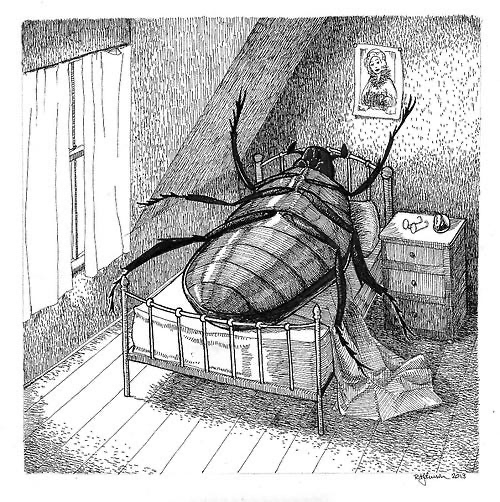
Even though Franz Kafka passed away over a century ago, we still talk about him today. While not everyone has read his works, many are familiar with the image of an insect lying on its back, legs flailing in the air—a visual inspired by his novella The Metamorphosis (1915).
This classic is not only frequently discussed in German literature classes but is also gaining new popularity online. On platforms like Instagram and TikTok, the hashtag #Kafka has hundreds of thousands of posts, and people are loving him. Some of the most popular quotes include: “I was ashamed of myself when I realized that life was a masquerade and I had come with my real face,” “The meaning of life is that it ends,” and “Love is that you are the knife I turn inside myself.” These lines, filled with melancholy, frustration, and bitterness, resonate with thousands of fans who not only admire Kafka but also use his words in memes to combine deep emotions with humor.
So why is Kafka’s popularity rising in today’s world, especially among Generation Z?
Gen Z has been labeled the “loneliest generation,” partly because they’re the first to grow up with smartphones and social media from a young age. The COVID-19 pandemic, starting in 2020, pushed even more people into isolation, making the internet a place of refuge. This comfort and security found in the digital world led to a rise in social anxiety, depression, and fear of real-world interactions, as many got used to the quiet, solitary life. Even after quarantine ended, a lot of young people remained in their rooms, finding it hard to return to social life.
One reason Kafka resonates so strongly with this generation is that, in a world full of curated Instagram perfection, he feels refreshingly real and relatable. People see themselves in his work, as he captured emotions—like longing, sadness, and loneliness—that are hard to express. His most famous work, The Metamorphosis, tells the story of Gregor Samsa, who is rejected by his family after turning into a giant insect. He yearns for closeness with his sister, but even she turns away, and his employer casts him aside because he’s no longer useful. The deep metaphor is clear—a reflection of societal rejection. It’s no surprise that the term “kafkaesque” was born, meaning “eerily oppressive, with no clear way out,” much like the world Kafka described. This word has become more relevant in our daily lives and even in online conversations.

However, not everyone is on board with the way Kafka and his works are celebrated online. Some argue that his suffering, along with that of others, is being romanticized in a way that makes dark emotions seem “cool” or “aesthetic,” especially in subcultures like “dark academia.” This glamorization risks trivializing mental health struggles.
There’s even a video game based on Kafka’s life, where players experience his difficult relationship with his father and his inner turmoil. This game has been criticized for making light of his pain, reducing it to mere entertainment.
I’d love to hear your thoughts on Kafka’s growing presence on the internet. Feel free to share your opinions in the comments below!


Leave a comment