
The first rule of Fight Club is: You do not talk about mental health.
The second rule of Fight Club is: You do NOT talk about mental health.
Welcome to an analysis of the movie Fight Club. Today we’ll be diving deeper into the psychology of this masterpiece and search for answers to questions no one asked. This article contains Fight Club spoiler!
Let’s start off with general information:
The psychological drama „Fight Club“(1999) is about a mentally ill protagonist, who founds a club for men to express their emotions through fighting. The movie was produced by David Fincher and is an adaption of the novel by Chuck Palahniuk. It’s a combination of thriller, drama and action and has been one of the most discussed movies since 1999, thematizing mental health, existential angst, capitalism and masculinity. Ironically, companies that were criticized in the movie, supported the production with a budget of 75 million dollar.
An anonymous narrator, played by Edward Norton, lives a busy life in a capitalistic world. He is a hardworking, introverted man who struggles with his place in the world.
He desperately yearns for connection and belonging, which is why he fakes cancer to be part of a community and to get closeness he didn’t get as a child.
Then there is Tyler Durden, who reflects all of the narrators struggles, desires and basically everything he wishes he was. He rejects materialism, speaks up for himself and breaks free from societal norms. He is also responsible for the emerge of Fight Club – a club founded for men to let out their suppressed feelings through fighting. As the movie goes on, you quickly realize that something is a bit off and Tyler turns out to be the narrators alter ego instead of a real person. He dies as the narrator shoots himself in the head.
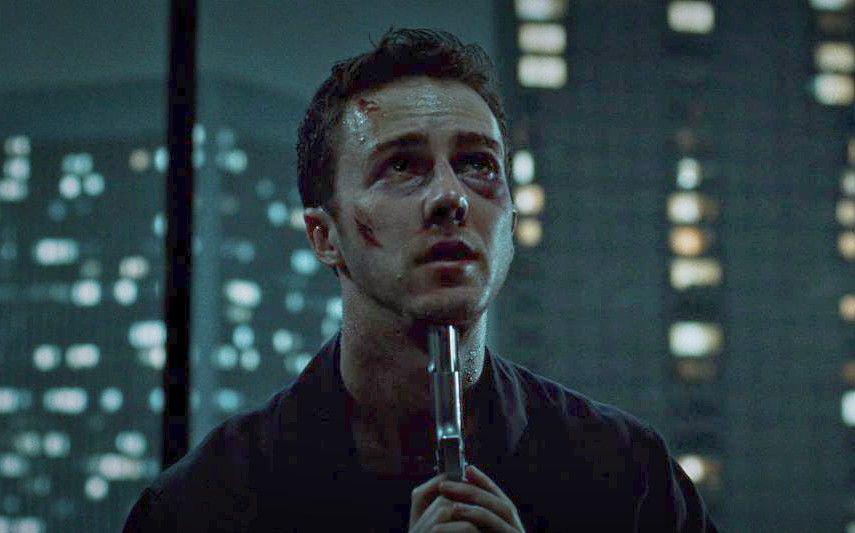
What’s the narrators psychological disorder?
I have heard many people bring up schizophrenia when talking about this movie, just because there is a person who does not really exist. You may also think the narrator has a borderline or multiple personality disorder due to his two personalities, but the more you know about him, the more you understand that in fact, it’s a dissociative identity disorder, which is a mental health condition where you have two or more separate personalities that control your behavior at different times. When personalities switch, you’ll have gaps in your memory. This is shown by the protagonist not remembering his actions as Tyler Durden, such as creating Fight Club and Project Mayhem. Him not evening realizing that he IS Tyler, represents his loss of control – another symptom.
DID is usually caused by trauma.
The movie barely exposes the narrator’s traumatic past, but what we do know is that his parents have an unstable relationship, which affected him at a very young age. There are many scenes in which the narrator mentions his parents, that describe his relationship to them:
1. Example: “I’m 6 years old again passing messages between parents.”
2. Example: *Talking about his father* “He left when I was like 6 years old.”
All the repressed rage and dissatisfaction with his corporate life led to that state.
Furthermore, he suffers from insomnia, which is not a symptom but a driving force behind his dissociation. It blurs the line between reality and hallucination, making him more susceptible to losing control over his identity. His sleeplessness leads to memory lapses and weakens his sense of self, making it easier for his subconscious (Tyler) to take over.
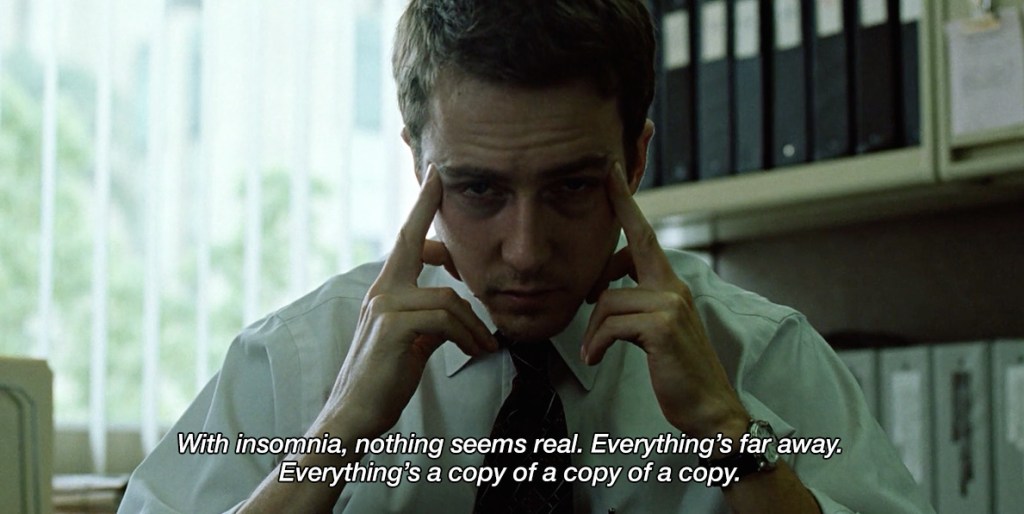
Long-term insomnia also has severe effects on cognitive function, including loss of time perception and impaired judgement, which is why the narrator makes increasingly irrational choices, from fighting strangers to participating in acts of terrorism. This being said, he cannot distinguish between what he has done and what he thinks he has done, leading to severe confusion.
The Irony of Tyler as a “Cure” for Insomnia
At first, Tyler seems to offer a solution – after meeting him, the narrator finally “sleeps.” But in reality, this is because Tyler takes over during these periods, meaning the narrator loses control rather than finding true rest. Instead of resolving his insomnia, Tyler turns it into a full dissociative crisis.
Conclusion
Overall, they are both dependent on each other and play a huge role in showcasing mental illness and yearning. If Tyler wasn’t there, the narrator would have been stuck in a depersonalized system that he hates and without the narrator, Tyler would have been a dangerous man to society, who would have founded his own cult just to kill people for fun. The protagonists healing journey starts at the end, when he realizes Tyler is a part of himself and attempts to reclaim control by acknowledging him, instead of choosing suppression.
I think Fight Club covers so many topics, so be prepared for another analysis focusing on toxic masculinity shown in the movie.
What do you think about the movie and its representation of mental health? Let’s discuss in the comments!


Leave a comment